Holiday car trouble
What to do when your mechanic is shut
The workshop closes on Christmas Eve and the diary does not open again until January. Here is exactly which days are shut, what is still running, and how to decide whether the car can wait for the first working Monday of the year.

Need to know
- The shutdown is not one day. From 5pm on Thursday 24 December there are four consecutive non-business days, then a three-day working window, then another three-day block over New Year.
- Roadside assistance runs straight through it. Workshops, dealer service departments and parts suppliers do not.
- In New South Wales the regulated tow fees carry a 20% after-hours surcharge, and business hours exclude public holidays. Almost every holiday tow is an after-hours tow.
- Where the car is towed to matters more than when. A holding yard starts a daily storage charge that runs for the whole shutdown.
The shutdown, day by day
Most people picture the shutdown as Christmas Day and Boxing Day. The dates for 2026-27 are worse than that, because Christmas Day falls on a Friday and every state except Tasmania picks up a substitute Monday.
| Date | What it is | Where it applies |
|---|---|---|
| Thu 24 Dec | Last full working day | Part-day public holiday from the evening in the Northern Territory, Queensland and South Australia |
| Fri 25 Dec | Christmas Day | Public holiday in every state and territory |
| Sat 26 Dec | Boxing Day, Proclamation Day in South Australia | Public holiday everywhere except Tasmania |
| Sun 27 Dec | Weekend | Not a business day |
| Mon 28 Dec | Substitute day | Public holiday in every state and territory. In Tasmania this is Boxing Day itself |
| Tue 29 to Thu 31 Dec | Three ordinary working days | The only window in the fortnight. New Year's Eve is a part-day holiday from the evening in the Northern Territory and South Australia |
| Fri 1 Jan | New Year's Day | Public holiday in every state and territory |
| Mon 4 Jan | First ordinary working day of 2027 | No substitute day anywhere |
Dates from the Fair Work Ombudsman's published 2026 and 2027 public holiday lists. Part-day holidays run from 6pm in Queensland and from 7pm in the Northern Territory and South Australia.
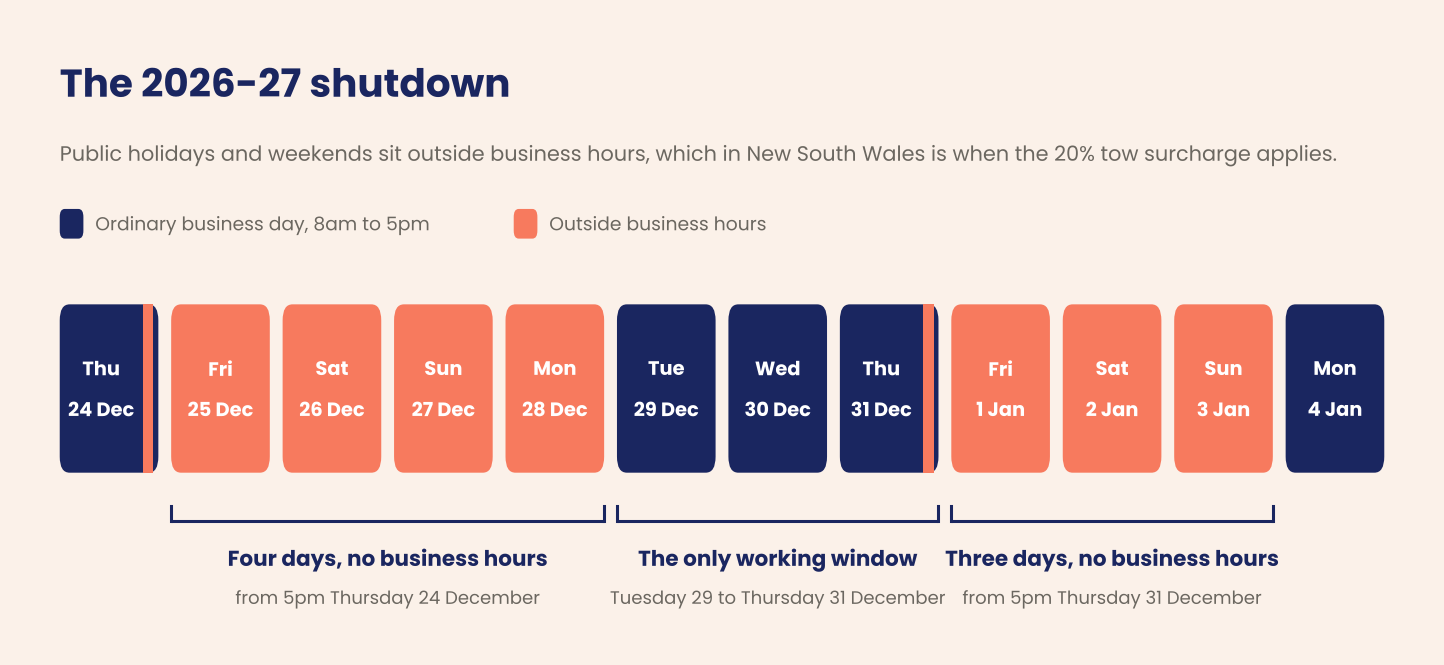
Then three working days. Then another three-day block from the evening of Thursday 31 December to Monday 4 January. Those three days in the middle are the only chance in a fortnight to move a car, order a part or speak to a service manager, and most people spend them not thinking about the car.
What is actually open

The useful question is not whether anything is open. It is which of the four things you might need is open, because they close at different times and for different reasons.
| Service | Over the shutdown | The detail that decides it |
|---|---|---|
| Roadside assistance | Runs through the shutdown | The auto clubs operate on public holidays. This is the one service that does not stop |
| Tow operators | Run through the shutdown | Available, and in New South Wales the regulated after-hours surcharge applies on every public holiday and weekend |
| Independent workshops | Mostly shut, often two to three weeks | No announcement and no published date. The reopening date is usually only on the answering machine message |
| Dealer service departments | Mostly shut over the public holidays | Some large groups keep a skeleton roster in the three-day window. Worth one phone call, not worth assuming |
| Parts suppliers and distributors | Shut, and this is the real constraint | A workshop that is open cannot fit a part it cannot order. This is why a job that would take a morning in March takes until mid January |
| Tyre and battery chains | Trading on the shopping days | These sit in shopping centres and follow retail trading hours rather than workshop ones |
The last row is the one worth remembering. A flat battery and a damaged tyre are the two most common summer faults the auto clubs report, and they are also the two that a shopping centre can fix on 29 December.
The supply chain is the part nobody plans for. You can find a mechanic who is working. Finding a mechanic who is working and a distributor who can send the part the same week is a different problem, and it is the reason a holiday repair stretches into January even when somebody is answering the phone.
Can it wait until January?
There are only three situations, and they have different answers. The expensive mistake is treating the second one as if it were the third.
The car is not safe to drive
Red warning lights, a brake pedal that has gone soft or long, the temperature gauge in the red, smoke or a burning smell, steering that pulls or shakes, or anything that started after an impact. This is a tow, and the decision that matters is where to tow it, not when.
The car drives but something is wrong
An amber light, a new noise, a slow leak, air conditioning that has stopped. This is the one people get wrong in both directions. Some of these will sit happily for three weeks. Some of them turn into the first category on a hot afternoon halfway through a long drive. The handbook in the glovebox tells you which, and it is the only document in the car written by the people who built it.
The car is fine and a service is due
Rebook it. There is nothing a January service does that a December one does better, and the week before Christmas is the single hardest appointment of the year to get. The one exception is a long drive: a service before a thousand kilometres of hot highway is worth moving other things for.
If it stops on a road, the safety sequence comes before the repair question. RACV's published guidance is to move as far left as you can, put the hazard lights on and leave them on, and not to stop just after a bend where nobody can see you. If you are a safe distance from traffic, stay in the car with your seatbelt on. If you are not, get out through the passenger door so the car is between you and the traffic, and stand as far from the road as possible.
Safety steps as published by RACV on 24 December 2025. The same guidance notes that in Victoria other drivers must slow to 40 km/h when passing a stationary roadside assistance vehicle with its lights flashing. A version of that rule now exists in every state, but the speed and the conditions differ: 40 km/h in New South Wales, Queensland, Tasmania, Western Australia and the Australian Capital Territory, 25 km/h in South Australia, and in some of them only below a posted limit of 80 or 90 km/h, above which the requirement is a safe and reasonable speed. Victoria extended its own rule to tow trucks and roadside assistance vehicles from 1 July 2025, the last state to do so. Check your own state's rule rather than carrying the Victorian number across the border.
What a holiday tow costs
New South Wales publishes maximum tow fees. That schedule is the only firm number available to anyone writing about this, and it contains a detail that changes what a holiday tow costs.
| Fee | Maximum | What it covers |
|---|---|---|
| Crash-related tow | $320 | The headline figure most people have heard |
| Recovered stolen vehicle | $211 | A separate, lower maximum |
| Each further tow | $116 | Applies to every tow after the first |
| Distance, Sydney metro | $7 per km | Beyond the first 10 km, by the most direct route |
| Distance, elsewhere | $6 per km | Beyond the first 20 km, by the most direct route |
| After-hours surcharge | 20% | Added to towing and salvage work outside business hours |
| Storage, Sydney metro | $34 per 24 hours | Per day or part day in an authorised holding yard. $18 outside Sydney metro |
Maximum fees for light vehicles up to 4.5 tonnes, published by the NSW Government and valid for the 2026 to 2027 period. The page was last updated on 1 July 2026. All figures exclude GST. These are New South Wales maximums and do not apply in other states.
Read that against the calendar above. Every hour from 5pm on Thursday 24 December to 8am on Tuesday 29 December falls outside business hours, and so does every hour from 5pm on Thursday 31 December to 8am on Monday 4 January. A holiday tow is an after-hours tow by definition, not by bad luck.
Put the two together and a crash tow that is capped at $320 is capped at $384 before GST for most of the fortnight. The storage line compounds faster. A car sitting in a holding yard from 25 December until a workshop reopens on 11 January is 17 days elapsed, and storage is charged per 24 hours or part of a day, so collecting it part way through the last day makes it 18. At the Sydney metro maximum of $34 a day that is $578 to $612 before GST on top of the tow, and at the $18 outside Sydney it is $306 to $324. Neither number is a forecast. Both are arithmetic on the published maximums.
Two things the same NSW guidance makes clear, and they are worth knowing at the roadside rather than afterwards. You can refuse a tow for any reason, including that the truck is not suitable. And the driver must give you a copy of the towing authorisation form and a quotation for the cost of the work. Ask for the quotation before the car goes on the truck, not after.
Two things nobody can tell you honestly
How many workshops actually close, and for how long
No Australian body publishes this. There is no survey, no register and no industry count, so a page that gives you a percentage is not drawing on a published source. The nearest related figures are older and about staffing rather than closures: the MTAA's 2021 industry report found 52% of automotive businesses reporting a skilled labour shortage and a national deficit of 31,143 positions, which the ABC reported in January 2024. Those are 2021 numbers and they say nothing directly about who opens over Christmas.
What a breakdown tow costs outside New South Wales
The NSW schedule names a crash tow, a stolen-vehicle recovery and each further tow. Other states regulate differently or not at all, and no comparable national price list exists. This is why the written quotation matters more here than almost anywhere else in motoring.
Where to have it towed

This is the decision with the largest number attached to it, and it is usually made in ninety seconds at the side of a road by someone who wants the problem to go away.
Home, if you have off-street parking
Almost always the cheapest answer. The car stops costing money the moment it is on your own driveway, and you tow it once more in January to wherever it is going to be fixed. Two short tows at a known price beat one tow plus seventeen days of storage.
The workshop that is going to do the work, but only after you have spoken to them
Ring the number and listen to the whole answering machine message before the truck moves. Most workshops put the reopening date on it. A car locked behind a roller door you cannot open is a car you cannot get a second opinion on, cannot sell and cannot move.
A holding yard, which starts a clock
Storage is charged per 24 hours or part thereof, which means an arrival at 11pm costs a full day. If the car has to go to a yard, make moving it one of the three things you do in the 29 to 31 December window.
Somewhere a tow driver suggests, with no price agreed
This is the one that becomes a dispute. If a destination is proposed to you rather than chosen by you, get the quotation in writing first. NSW Fair Trading takes towing complaints, and the published complaint line runs 8:30am to 5pm Monday to Friday, which over this fortnight means January.
The three working days between the two public holiday blocks are the whole game. If the car is going to move, move it then. Tuesday 29, Wednesday 30 and Thursday 31 December are ordinary business days, which means no after-hours surcharge, parts counters answering the phone, and a service manager who can at least put you in the January diary before everyone else rings on the fourth.
The bill you did not plan for
The last part of this is the one the calendar cannot help with. A repair you cannot defer is an unplanned cost arriving in the most expensive fortnight of the year, usually a week after Christmas has already been paid for.
There is no clever answer to that. The useful thing is to separate the two numbers before you make any decision: what the tow and the storage are costing you while the car waits, and what the repair itself will cost when somebody can finally look at it. The first number is running right now and is often the one people ignore. The second can usually wait for a proper quote in January.
Holiday car trouble FAQs
Are mechanics open over Christmas in Australia?
Most independent workshops and dealer service departments close over the Christmas and New Year public holidays, and many can be closed for two to three weeks. There is no published national figure for how many, because no Australian body collects it. In 2026-27 the public holidays are 25, 26 and 28 December and 1 January in every state and territory, except Tasmania where Boxing Day falls on 28 December instead of 26 December. The only ordinary working days in the fortnight are 29, 30 and 31 December.
Is roadside assistance available on Christmas Day?
Yes. The auto clubs operate through the public holidays, and the holiday period is one of their busiest. RACV reported more than 37,000 roadside call-outs in regional Victoria alone across December and January in 2024-25, well above the monthly average, in a release published on 19 December 2025. Check before the holidays that your membership has not lapsed and that the payment details on it are current.
How much does a tow cost over the Christmas holidays?
In New South Wales the maximum for a crash-related tow of a light vehicle is $320 excluding GST, plus distance charges beyond the first 10 km in Sydney metro or 20 km elsewhere. A 20% surcharge applies outside business hours, and business hours are 8am to 5pm Monday to Friday excluding public holidays, so nearly every tow over the holiday period attracts it. Other states regulate tow fees differently or not at all. Ask for the written quotation before the car is loaded.
Can I keep driving with a warning light on until the workshop reopens?
It depends entirely on which light. A red warning light generally means stop as soon as it is safe to do so. An amber light generally means have it looked at. The handbook in the glovebox lists what each one means for your specific car, and it is the only source written by the people who built it. If the brake pedal has changed, the temperature gauge is high, there is smoke or a burning smell, or the steering pulls or shakes, do not drive it to the workshop to save a tow fee.
What happens if my car sits in a holding yard over the shutdown?
Storage is charged per 24 hours or part of a day. The NSW maximum for a light vehicle is $34 a day in Sydney metro and $18 a day outside it, excluding GST. A car left from 25 December until a workshop reopens on 11 January is 17 days elapsed, or 18 charged days if you collect it part way through the last one, so $578 to $612 in Sydney metro and $306 to $324 outside it, before GST and on top of the tow. If the car has to go to a yard, moving it during the 29 to 31 December working window is usually the cheapest thing you can do.
When do workshops reopen in January?
There is no common date and no published figure. The first ordinary working day of 2027 is Monday 4 January, with no substitute public holiday anywhere in the country, but many workshops stay closed well past it. The reliable method is to ring the workshop before the shutdown and listen to the whole answering machine message, which is usually where the reopening date is recorded.
Important information: This article provides general information only and does not guarantee that any credit application will be approved. Any application is subject to assessment and the applicable eligibility criteria, fees and terms. Please refer to the relevant product information and credit contract for details.
All applications are subject to credit assessment and eligibility criteria. AutoSwift Finance is operated by Koala Enterprises Pty Ltd (Australian Credit Licence 537359).