Christmas 2026
What is actually open over Christmas
Christmas Day closures are set by eight different state laws, not by the shops. Here is which days are restricted where, what is exempt, and what stops moving behind the scenes while the doors are shut.

Need to know
- Christmas Day is a restricted trading day in New South Wales, Victoria, Queensland, South Australia, Tasmania and Western Australia. Trading is deregulated in the Australian Capital Territory and largely so in the Northern Territory.
- Boxing Day is restricted only in New South Wales, and even there any shop may trade if it is staffed only by people who freely elected to work.
- Payments do not all keep running. Anything on the New Payments Platform clears in seconds every day of the year. Direct entry and BPAY can take up to three business days, and the fortnight has only three of those.
- Card surcharges were banned from 1 October 2026. Weekend and public holiday surcharges were not, and this is the first Christmas under both rules at once.
The fortnight, day by day
Christmas Day 2026 falls on a Friday, which is the arrangement that produces the longest closure. Monday 28 December is a public holiday in every state and territory, so the first block runs four days. Six states and territories and South Australia take it as an additional day on top of 26 December; Tasmania is the one place where it is Boxing Day itself.
| Date | What it is | Where it applies |
|---|---|---|
| Thu 24 Dec | Last full working day | Part-day public holiday from 6pm in Queensland and from 7pm in the Northern Territory and South Australia |
| Fri 25 Dec | Christmas Day | Public holiday everywhere, and a restricted trading day in six of the eight |
| Sat 26 Dec | Boxing Day, Proclamation Day in South Australia | Public holiday everywhere except Tasmania. A restricted trading day only in New South Wales |
| Sun 27 Dec | Weekend | Not a business day |
| Mon 28 Dec | Additional day for Boxing Day | Public holiday everywhere. The Fair Work Ombudsman lists it as an additional day rather than a substitute, so 26 December stays a public holiday as well. In Tasmania this is Boxing Day itself |
| Tue 29 to Thu 31 Dec | Three ordinary working days | The only working window in the fortnight. New Year's Eve is a part-day holiday from 7pm in the Northern Territory and South Australia |
| Fri 1 Jan | New Year's Day | Public holiday everywhere. Not a restricted trading day |
| Mon 4 Jan | First ordinary working day of 2027 | The Fair Work Ombudsman's 2027 list carries no additional or substitute day in January anywhere |
Public holiday dates from the Fair Work Ombudsman's published 2026 and 2027 lists. Restricted trading days are set separately by each state's own retail trading legislation, which is the table below.
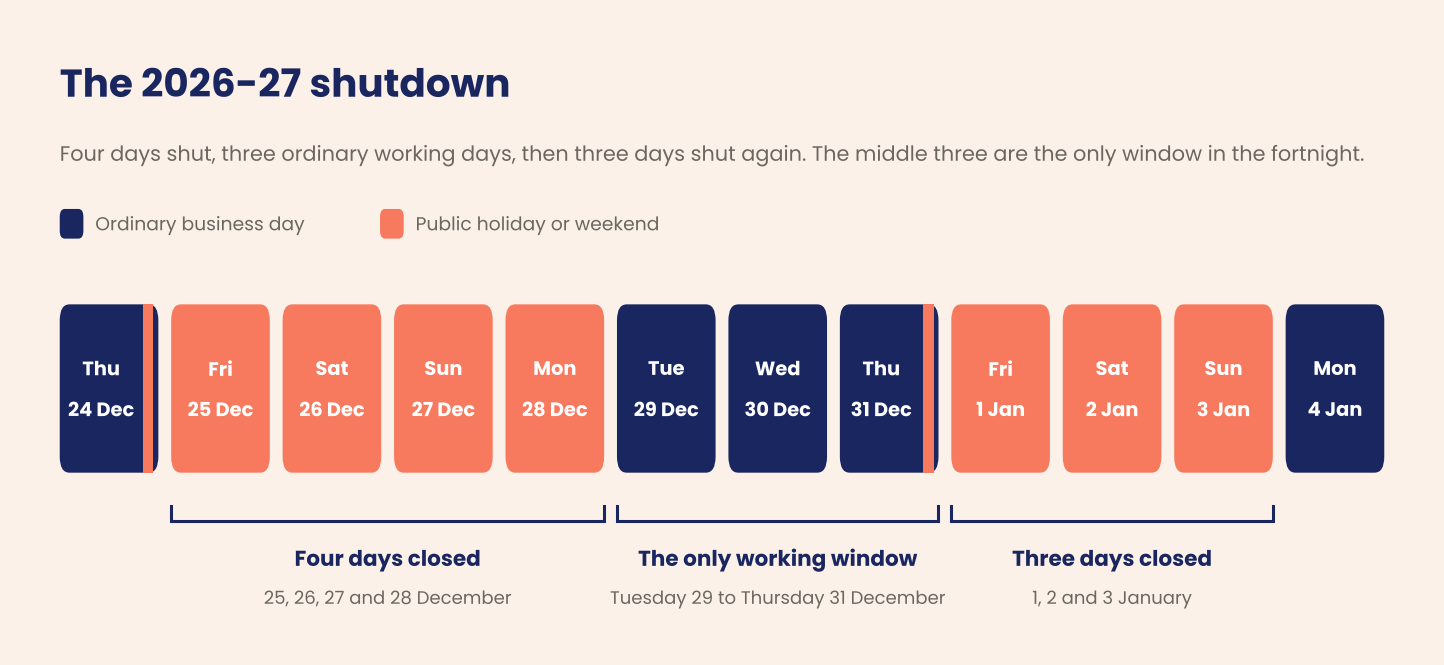
A public holiday decides what people get paid. A restricted trading day decides whether the door can legally open at all. New Year's Day is a public holiday in every state and a restricted trading day in none of them, which is why the shops are open on 1 January and shut on 25 December.
The law, state by state

There is no national retail trading law. Each state and territory writes its own, and they disagree about which days are restricted, which shops are exempt and how big a shop has to be before the rules bite.
| Where | Restricted trading days | How it works |
|---|---|---|
| New South Wales | Christmas Day and Boxing Day | Retail Trading Act 2008. Exempt shop types in Schedule 1 include chemists, fruit and vegetable shops, restaurants, cafes, take-away shops, book shops, florists, petrol stations and vehicle shops. Small shops are exempt under section 8. Under section 8A any shop may open on Boxing Day if staffed only by people who freely elected to work |
| Victoria | Christmas Day | Shop Trading Reform Act 1996. Victoria has two and a half restricted trading days a year: Good Friday, Christmas Day and Anzac Day until 1pm. Exempt types are chemists, petrol shops, restaurants, cafes and take-away outlets. A shop is also exempt with 20 or fewer people working on the day and no more than 100 across related entities in the preceding seven days |
| Queensland | Christmas Day | Independent retail shops must close on Christmas Day unless they are predominantly a food or grocery store. Extended trading applies for the three Sundays before 18 December and from 18 to 24 December. Non-exempt shops trade to midnight from 18 to 23 December and close at 6pm on Christmas Eve |
| South Australia | Christmas Day | Shop Trading Hours Act 1977 and the Shop Trading Hours Regulations 2018. The CBD Tourist Precinct, the Metropolitan Shopping District and Proclaimed Shopping Districts close. Exemptions turn on location, size and what the shop sells |
| Western Australia | Christmas Day | What a shop may do depends on its category and its location. Small retail shops may trade at any hour on any day, and special retail shops including service stations trade 6am to 11.30pm. General retail shops carry the Christmas and public holiday rules |
| Tasmania | Christmas Day | Shop Trading Hours Act 1984 restricts large retailers. Tasmania is also the one jurisdiction where Boxing Day is not a public holiday on 26 December: it falls on Monday 28 December |
| Australian Capital Territory | None | Trading hours are deregulated. Christmas Day, Boxing Day and New Year's Day are public holidays, but a shop decides for itself whether to open |
| Northern Territory | Largely none | Trading is mostly deregulated, with conditions on stores selling liquor. Christmas Eve and New Year's Eve are part-day public holidays from 7pm |
Compiled in October 2026 from each jurisdiction's own retail trading legislation and regulator guidance, including Business Victoria's restricted trading days page, Business Queensland's Christmas trading hours page and the Retail Trading Act 2008 itself. Exemptions are summarised, not reproduced. This is general information, not legal advice. If you are a retailer deciding whether to open, read your own state's Act, or take your own advice, rather than rely on this table.
One line in the New South Wales Act is worth knowing whichever side of the counter you are on. Section 3A says a person has not freely elected to work if they were coerced, harassed, threatened or intimidated, and that being rostered, or being required to work under an industrial instrument, does not by itself count as freely electing. The Boxing Day exemption in section 8A rests entirely on that definition.
What that means at the shops
The practical version of all that, for the four things people actually go looking for on Christmas Day.
| What | On Christmas Day | Why |
|---|---|---|
| Supermarkets | Closed on Christmas Day in most of the country | A major supermarket is not an exempt shop type anywhere except where the whole jurisdiction is deregulated. Queensland's exception is for shops that are predominantly food or grocery stores, which is narrower than it sounds |
| Chemists | Generally able to open | Chemists are a named exempt type in New South Wales, Victoria and Queensland. Whether an individual one opens is a commercial decision, so ring first |
| Petrol stations | Generally able to open | Named as exempt in New South Wales, Victoria and Queensland, and covered as special retail shops in Western Australia. This is usually the only place selling anything at all on Christmas Day |
| Restaurants, cafes and takeaway | Able to open | Exempt in every state that restricts trading. The constraint on Christmas Day is bookings and staffing, not the law |
| Bottle shops | Depends on the licence | In New South Wales a packaged liquor licence does not by itself create an exemption, while hotel and small bar licences do. Queensland sets Christmas and New Year liquor hours separately under its own Act |
| Boxing Day sales | Open almost everywhere | Only New South Wales restricts Boxing Day, and section 8A lets any shop open with willing staff. This is why Boxing Day is a national sale event and Christmas Day is not |
No individual retailer's 2026 hours are listed here on purpose. Chains publish them in December, store by store, and they change. The table above is the law, which does not. For a specific shop, the store locator on its own site is the only reliable source, and it is worth checking the day before rather than the week before.
What stops moving

The part nobody puts on a trading-hours page is what happens to money over the same fortnight, and it is where the shutdown actually costs people something.
Fast payments do not stop, and slow ones do
The New Payments Platform runs 24 hours a day, 365 days a year, and each payment settles in real time in central bank funds through the Reserve Bank's Fast Settlement Service. That is what sits behind PayID and Osko. Direct entry and BPAY are a different system: Australian Payments Plus states those can take up to three business days to clear. Over this fortnight there are only three business days, so a direct entry payment sent on Christmas Eve may not have cleared before New Year's Eve.
Card surcharges are gone, and this is the first Christmas without them
From 1 October 2026 businesses can no longer surcharge Visa, Mastercard and eftpos credit, debit and prepaid cards, or American Express. The ACCC states that its earlier rules capping surcharges at the cost of acceptance ended on the same date. Two details are worth knowing. American Express sits outside the Reserve Bank's rules and removed surcharging by its own decision from that date rather than by regulation. And the no surcharge rules are enforced by the card networks and payment providers, not by the ACCC. If a terminal still adds a card fee on Christmas Day, that is not a holiday surcharge, it is a card surcharge that should not be there.
Public holiday surcharges were not banned, and they have rules
The ACCC is explicit that weekend and public holiday surcharges in hospitality are unaffected by the card ban. What they must do is appear on the menu in the words "A surcharge of [percentage] applies on [day or days]", at least as prominent as the most prominent price on that menu. If the menu has no prices, it has to be displayed prominently some other way. A surcharge you only discover on the bill has not met that test.
A card fee wearing a different hat is still a card fee
The ACCC warns that disguising a card surcharge as another fee may be misleading conduct. A new line item appearing this December, on a bill where the card surcharge used to be, is worth asking about before you pay it rather than after.
Why the surcharge exists at all
Hospitality penalty rates are mandatory for weekend and public holiday work. ABC News reported in January 2025 that casual rates run at 150% of the ordinary hourly rate on Saturdays, 175% on Sundays and 250% on public holidays. That is the cost the surcharge is covering, and it is why a 25 December booking is priced differently from a 27 December one.
New Payments Platform availability and the three business day figure for direct entry and BPAY from Australian Payments Plus. Card surcharge and price display rules from the ACCC, pages last updated 2 October 2026. Penalty rate percentages as reported by ABC News on 16 January 2025.
What else is shut
Retail is the part with a statute behind it. Everything else closes by custom, which means there is no published date and no announcement.
Workshops, dealer service departments, dentists, physiotherapists and most trades shut somewhere between Christmas Eve and the middle of January. Parts distributors go with them, which is the constraint people underestimate: a workshop that is open still cannot fit a part it cannot order. RACV reported more than 37,000 roadside call-outs in regional Victoria alone across December and January in 2024-25, well above the monthly average, in a release published on 19 December 2025. The faults it names as most common over summer are flat batteries, tyre damage, lockouts and mechanical faults made worse by heat and long drives.
We have written the long version of that separately, including what a tow actually costs once the after-hours surcharge is counted and where to have a car taken when the workshop is locked: what to do when your mechanic is shut until January.
Tuesday 29, Wednesday 30 and Thursday 31 December are ordinary business days. Direct entry clears, parts counters answer, service managers are at their desks and no after-hours surcharge applies. Anything that has to happen between Christmas and the fourth of January has to happen then.
Two things nobody can tell you honestly
What any individual chain will do this year
Retailers publish their Christmas hours store by store in December, and they change them. Anyone telling you in October what a particular shopping centre will do on 26 December is guessing. The law above is settled; the hours are not.
How many non-retail businesses close, and for how long
No Australian body publishes this. There is no survey and no register for workshops, trades or allied health, so a page that gives you a percentage is not drawing on a published source. Ask where the number came from before you plan around it.
Christmas trading FAQs
Are the shops open on Christmas Day in Australia?
Mostly no. Christmas Day is a restricted trading day in New South Wales, Victoria, Queensland, South Australia, Tasmania and Western Australia, which means shops must be closed rather than choosing to be. Exempt types vary by state but generally include chemists, petrol stations, restaurants, cafes and take-away outlets. Trading is deregulated in the Australian Capital Territory and largely so in the Northern Territory, so shops there decide for themselves.
Is Boxing Day a restricted trading day?
Only in New South Wales, and even there section 8A of the Retail Trading Act 2008 lets any shop open on Boxing Day provided it is staffed only by people who freely elected to work that day. Everywhere else Boxing Day is a public holiday but not a trading restriction, which is why it works as a national sale day and Christmas Day does not.
Are the shops open on New Year's Day?
New Year's Day is a public holiday in every state and territory but it is not a restricted trading day anywhere. Shops may open, and most larger ones do. What changes is staffing cost rather than legality.
Will a bank transfer go through over the Christmas holidays?
It depends which system it uses. The New Payments Platform, which is what PayID and Osko run on, operates 24 hours a day, 365 days a year and settles in real time, so a payment sent on Christmas Day arrives on Christmas Day. Direct entry and BPAY can take up to three business days according to Australian Payments Plus, and between 24 December 2026 and 4 January 2027 there are only three business days in total.
Can a restaurant charge extra on Christmas Day?
Yes. Weekend and public holiday surcharges in hospitality were not affected by the card surcharge ban that took effect on 1 October 2026. The ACCC requires the menu to carry the words "A surcharge of [percentage] applies on [day or days]", at least as prominent as the most prominent price on the menu, or displayed prominently another way if the menu has no prices. A surcharge you first see on the bill has not met that requirement.
When is the first normal working day after Christmas?
Tuesday 29 December 2026 is an ordinary business day, as are 30 and 31 December. After New Year's Day on Friday 1 January 2027 the next ordinary working day is Monday 4 January, with no substitute public holiday anywhere in the country. Many non-retail businesses stay closed well past it.
Important information: This article provides general information only and does not guarantee that any credit application will be approved. Any application is subject to assessment and the applicable eligibility criteria, fees and terms. Please refer to the relevant product information and credit contract for details.
All applications are subject to credit assessment and eligibility criteria. AutoSwift Finance is operated by Koala Enterprises Pty Ltd (Australian Credit Licence 537359).