Christmas lights
Christmas lights: where to see them
Nobody keeps an official register of Christmas light displays. Four community databases do the job instead. Here is which one covers what, the week to avoid if you want to actually park, and how to work out what your own display costs.

Need to know
- There is no official register of Christmas light displays in Australia. Every map you will find is crowd-submitted and maintained by volunteers or a small business. There are three with national coverage, not the four a search suggests.
- Search interest peaks in the week of 21 December and is under half of that in late November, 39 against 100 on the relative index, so going early is the difference between parking and crawling.
- A display's running cost is simple arithmetic you can do in one line, and it does not need anyone's national average. Watts, hours, then the rate printed on your bill.
- Energy Safe Victoria's published guidance is specific: outdoor equipment needs an IP23 rating at minimum, extension leads must be fully unwound, and plugs without insulated pins mean the set is over fifteen years old.
When to go
Displays go up through November and come down within days of Christmas. The question worth answering is not when they are on, which is most of December, but which night you will be able to move.
We measured it rather than guessed. Searching for Christmas lights in Australia builds steadily from late October, roughly doubles across the last week of November, sits high through the first half of December and then spikes in the week before Christmas. The week of 21 December reads 100 on the index. The week of 23 November reads 40.
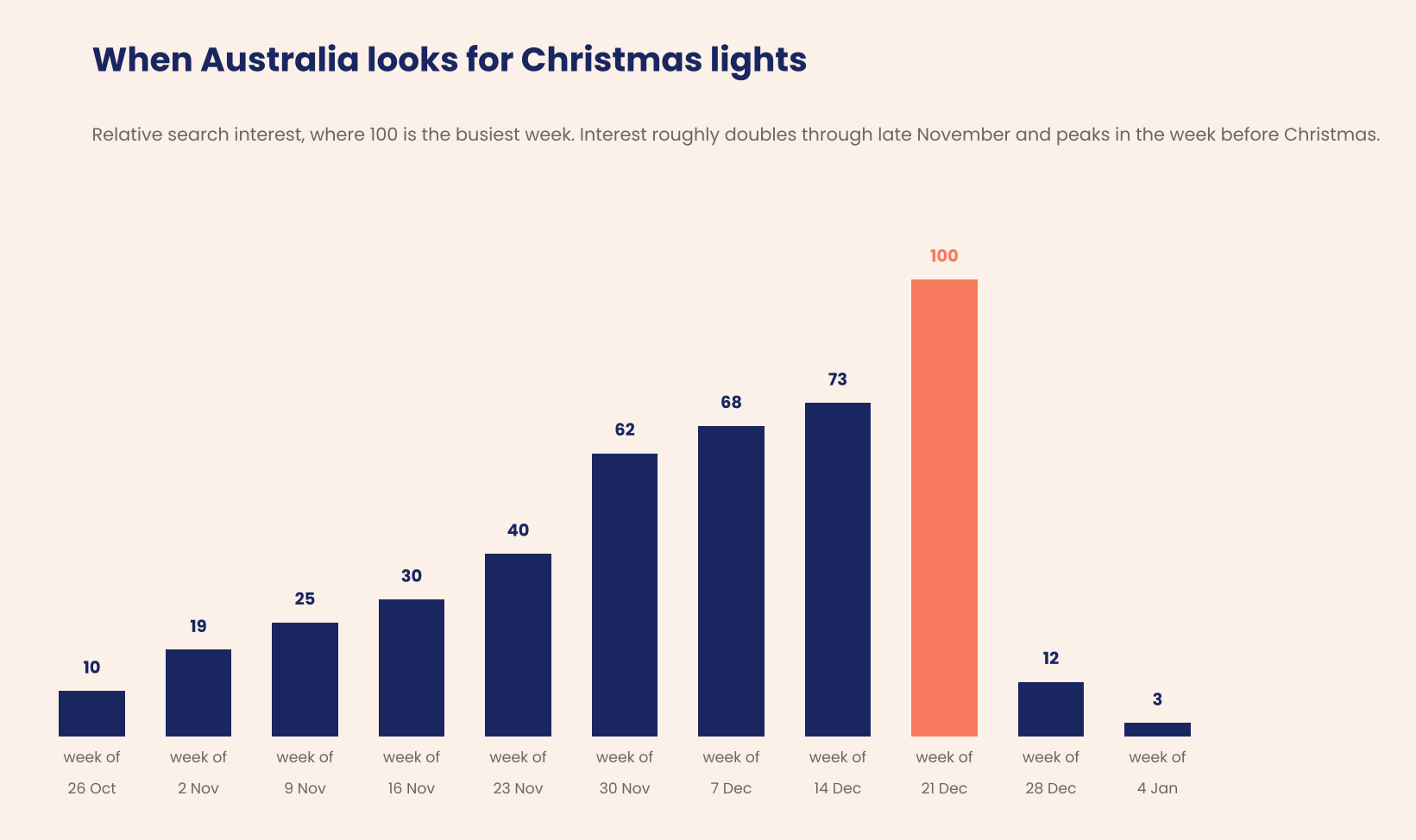
Nearly everything is lit by the start of December and search interest is about two thirds of what it will be a fortnight later: 66 in each of the first two weeks against 100 in the week of 21 December. That is a proxy for how busy a street will be, not a count of cars. The week of 21 December is when the streets around the big residential displays stop working, and it is also the week school holidays start and everybody is free on the same four nights.
Go on a weeknight, not a Friday or Saturday
The big residential displays are in ordinary streets with ordinary parking. A Tuesday in early December and a Saturday a fortnight later are not the same experience.
Check the display's own hours before you drive
Most run roughly dusk to about 10pm, and many switch off earlier on weeknights. The community maps carry hours for some listings and not others, so the listing is a starting point rather than a timetable.
Park once and walk the street
Where several houses on one street are lit, the street itself is the display. Driving it slowly is what creates the queue everybody is complaining about.
Bring a donation
Many of the larger home displays collect for a charity, usually with a tin or a QR code at the fence. It is the closest thing to an entry fee and it is voluntary.
Where to find displays

No government body maintains a national list. What exists is three independent databases, all crowd-submitted, each with a different strength. They cover much of the same ground, so the useful question is which one to open first. "Christmas Lights Map" is worth knowing as a phrase rather than a place: it is the title two of these three use for their own map pages, and a dozen local guides use it as well, so searching it does not take you anywhere in particular.
| Source | What it gives you | The detail that decides it |
|---|---|---|
| AusChristmasLighting | Display locations across Australia, New Zealand and overseas | The widest geographic coverage of the three, and listings carry the display's own dates, which is more than most. Its map was current for the 2026 season when we checked it |
| Christmas Light Search | State pages plus postcode search | The easiest to use if you know your postcode and want the nearest few rather than a whole map. It publishes a page per state |
| Aussie Christmas Lights | Interactive map with photos, ratings and route tools | Photos and community ratings out of five make it the best of the three for deciding whether a display is worth the drive, and it has favourites and route planning. It does not publish display hours, and its own terms do not guarantee hours or current status |
All three are independent and community-maintained, and all three were live and carrying 2026 listings when we checked them in October 2026. None is an official register, none verifies a listing on the ground, and a house that was lit last year stays on the map until somebody says otherwise. Treat a listing as a lead, not a guarantee, and check its date before you drive. We make no claim about which of the three is oldest: none of them publishes a founding date.
Two other sources are worth a look and are often better than any of the three for the week you are actually going. Your local council frequently publishes a map or a list of its own, particularly where a single street is well known, and local parenting and community news sites compile a regional list every year with the dates checked. Both are small, local and current, which is exactly what a national database struggles to be.
The large public displays are a separate category. Capital city council installations, botanic garden light trails and ticketed events publish their own dates, times and prices on their own sites, usually from about mid November. Those are the ones to book rather than drive past, and the only reliable source for them is the venue.
What it costs to run
Every page that answers this quotes a national average. There is no national average, because nobody collects wattage data across Australian households. What there is, is three numbers you already have.
Find the watts
It is on the box, on the transformer, or in the specifications on the retailer's product page. Add up every set you are running. If a set gives only volts and amps, watts is the two multiplied.
Work out the hours
Count the nights and the hours per night. A display run from dusk to about 10pm, say six hours a night, for the six weeks from the middle of November, is around 250 hours for the season.
Turn that into kilowatt hours
Watts multiplied by hours, divided by 1,000. A 100 watt display over 250 hours is 25 kilowatt hours for the whole season.
Multiply by the rate on your own bill
Your usage rate in cents per kilowatt hour is printed on your electricity bill. That is the only rate that applies to you. If it were 30 cents, those 25 kilowatt hours would cost $7.50 across the season; at 40 cents, $10. The arithmetic is the point here, not those two rates, which are only there to show the shape of it.
Energy Safe Victoria names solar, LED and extra-low-voltage sets at 5, 12 or 24 volts as the safest options, because they prevent shocks and overheating fires. They are also the ones that draw almost nothing. If your running cost feels high, the wattage on the box is where to look, and it is the same thing the safety advice is pointing at.
If you are putting them up
Energy Safe Victoria publishes a specific list rather than general advice. It is guidance rather than legislation, and it does not cite any, but several items on it describe product standards in mandatory terms. These are the ones people most often get wrong, in its own words.
| What | The rule | In full |
|---|---|---|
| Outdoor rating | At least IP23 | Outdoor equipment must carry an IP rating of at least IP23, with weatherproof connections. Some transformers have to stay indoors and out of the weather |
| Voltage | Solar, LED or 5, 12 or 24 volts | Named as the safest options for preventing shocks and overheating fires, and the recommendation for outdoor use |
| Extension leads | Factory-made, fully unwound | Use factory-made leads or ones made by a licensed electrical contractor, and unwind them completely so they do not overheat. Do not run them across walkways or driveways, or through doorways and windows |
| Power boards | With overload protection | No double adaptors and no piggy-backed plugs. Running several high-powered lamps can overload the circuit |
| Safety switch | Test it | Test the safety switch and the smoke alarm regularly. If there is no safety switch, have one installed or use a portable one |
| Old sets | Check the plug pins | Plugs without insulated pins mean the decorations are more than fifteen years old and should be replaced. Check older sets against the Product Safety recalls site, and have second-hand sets checked by a licensed electrician |
| Unattended | Switch them off | Turn decorative lights off before bed and before leaving the house. Switch off and unplug before watering a living tree, and make sure the power is off while putting lights up or changing bulbs |
| Weather | Secure them, then turn them off | Secure outdoor lights against wind and storms and switch them off in poor weather. Keep lights and leads away from pools and wet areas, and keep flood and halogen lamps away from anything that could catch fire |
Summarised from Energy Safe Victoria's Christmas light safety guidance, which still carries its 27 August 2024 review date. It is written for Victoria and we make no claim about what applies elsewhere. Your own state's electrical safety regulator publishes an equivalent page, and Queensland's Electrical Safety Office is the obvious example. The fifteen year figure is Energy Safe Victoria's own inference from the rule that appliances sold after 2006 must have insulated pins, not a legal threshold.
Two things nobody can tell you honestly
Which houses will actually be lit this year
The maps are crowd-submitted and nobody checks them on the ground. A listing is last year's house until someone updates it, and the people most likely to update it are the households running the biggest displays. Small ones drop off quietly.
What the average Australian display costs to run
No Australian body collects wattage data across households, so there is no average to quote. A dollar figure for a typical display is a figure for one chosen display, so the useful question is which display, and at what wattage and tariff.
Christmas lights FAQs
Is there an official map of Christmas lights in Australia?
No. No government body maintains one. The national coverage comes from three independent community databases: AusChristmasLighting, Christmas Light Search and Aussie Christmas Lights. All are crowd-submitted, none verifies listings on the ground, and a house stays listed until someone updates it. "Christmas Lights Map" is a page title two of them use, not a fourth database. Councils and local community news sites often publish smaller lists that are more current for a particular area.
When is the best time to see Christmas lights in Australia?
The first two weeks of December. Almost everything is lit by then and far fewer people are looking. On our own Google Trends read for Australia, the week of 21 December reads 100 on the relative index while the week of 23 November reads 39 and the first two weeks of December read 66. That measures search interest rather than cars on the street, but a weeknight in early December and a Saturday close to Christmas are very different experiences of the same street.
How much do Christmas lights cost to run?
Work it out rather than trusting an average, because no Australian body collects the data an average would need. Add up the watts from the box or the product page, multiply by the hours you will run them, divide by 1,000 for kilowatt hours, then multiply by the usage rate printed on your electricity bill. A 100 watt display run six hours a night for six weeks is about 25 kilowatt hours for the season.
Are LED Christmas lights cheaper to run?
Substantially, because the running cost is driven by wattage rather than by how many globes are on the string. Energy Safe Victoria recommends solar, LED and extra-low-voltage sets at 5, 12 or 24 volts as the safest options, on the grounds that they prevent shocks and overheating fires. The same properties are what make them cheap.
What rating do outdoor Christmas lights need?
Energy Safe Victoria states that outdoor equipment must have an IP rating of at least IP23, and that connections must be weatherproof. It also notes that some transformers have to stay indoors, away from the weather, even when the lights themselves are outdoor-rated.
When do Christmas light displays usually switch off?
Most residential displays run from dusk to around 10pm, and many turn off earlier on weeknights. There is no common schedule, and the community maps carry hours for some listings and not others. Large public and ticketed displays publish their own times, and the venue's own site is the only reliable source for those.
Important information: This article provides general information only and does not guarantee that any credit application will be approved. Any application is subject to assessment and the applicable eligibility criteria, fees and terms. Please refer to the relevant product information and credit contract for details.
All applications are subject to credit assessment and eligibility criteria. AutoSwift Finance is operated by Koala Enterprises Pty Ltd (Australian Credit Licence 537359).